Yin and Yang
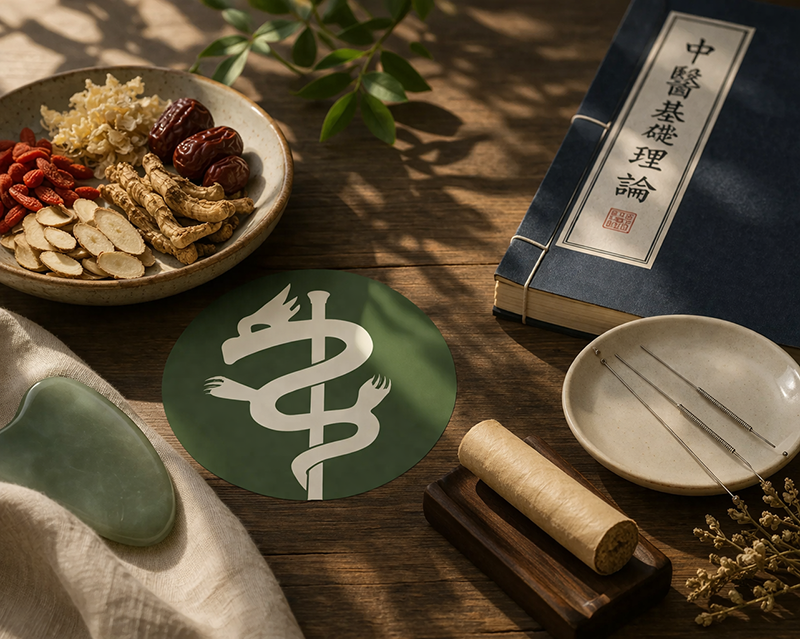
Yin and Yang: the foundation of Traditional Chinese Medicine
Few concepts are as characteristic of Traditional Chinese Medicine as Yin and Yang. The black-and-white symbol is recognized worldwide, but the depth of this principle goes far beyond a logo or decorative element. Yin and Yang form the philosophical backbone of TCM: they describe how reality is structured, how the human body functions, how illness arises, and how healing becomes possible. Anyone who wants to understand TCM must begin with Yin and Yang.
What do the Chinese characters say?
The terms Yin and Yang are not abstract philosophical concepts — they are rooted in a concrete, visual image: the mountain. The Chinese character for Yin refers to the shaded side of a mountain, the side where the sun does not shine. The character for Yang refers to the sunny side, the side where light falls abundantly. This simple image of light and shadow on a mountainside is the point of departure for one of the most influential philosophical systems in the world.
The character for Yin contains elements that refer to a "bank" or "hill" and "cloud" — images of covering, hiddenness, and coolness. The character for Yang contains elements for "sun," "rays of light," and "sun above the horizon" — images of brightness, warmth, and activity. Thus, even within the characters themselves, the qualities of Yin and Yang are already visible.
The essence: everything exists in relation
The Suwen, one of the classical texts of Chinese medicine from the second century BCE, formulates the core principle of Yin and Yang as follows: everything can be subjected to the opposites of Yin and Yang, but Yin and Yang are not absolute magnitudes. The principle itself is unchanging, yet everything that exists changes continually within that principle.
This is a subtle but crucial point. Yin and Yang are not fixed categories into which things are classified once and for all. They are relational: something is Yin or Yang only in relation to something else. Water is Yin in relation to fire, but Yang in relation to ice. A woman is Yin in relation to a man, but the Yang aspects of her body — her back, her head, her functions — are Yang. This relative character makes Yin and Yang a dynamic instrument of analysis, not a rigid classification system.
Yin and Yang in daily practice: the qualities
Although Yin and Yang are relative, they do have stable qualities that serve as a point of departure. Yin stands for the withdrawn, the dark, the quiet, the cold, the material, and the inward-directed. Think of night, winter, water, earth, and moon. Yang stands for the active, the bright, the warm, the light, the functional, and the outward-directed. Think of day, summer, fire, heaven, and sun.
In ancient China, this principle was applied literally in court ceremony. The emperor always stood facing south — the direction of the sun and therefore of Yang. With his back to the north (Yin), east on his left (Yang, where the sun rises), and west on his right (Yin, where the sun sets), he literally embodied the axis of Yin and Yang in space. Even architecture and the positioning of people and objects were determined by this principle.
The symbol: movement, not stillness
The well-known Yin-Yang symbol — a circle divided into a black and a white field, each containing a small dot of the other color — is not an accidental design creation. It is a precise visual representation of how Yin and Yang relate to each other and transform into one another.
If you examine the symbol closely, you see that from full Yang (white), Yin (black) gradually begins to take shape. Yang decreases until Yin reaches its peak. Then Yang begins to manifest again until it reaches its own peak. This is the cycle: day becomes night, night becomes day. Summer becomes winter, winter becomes summer. The small dot of Yin in the Yang field and the small dot of Yang in the Yin field symbolize that at the height of one, the seed of the other is already present. There is never absolute Yin or absolute Yang — they always already contain one another.
Yin and Yang as the basis of TCM diagnosis
In Traditional Chinese Medicine, every symptom, every complaint, and every bodily condition is traced back to the relationship between Yin and Yang. Heat, restlessness, redness, and dryness are Yang symptoms. Cold, fatigue, pallor, and fluid accumulation are Yin symptoms. The art of the TCM practitioner is to determine which aspect is out of balance and why — and then to align treatment accordingly.
This makes Yin and Yang more than philosophy: it is a diagnostic instrument. Without this foundation, there is no TCM. The theory of Yin and Yang is the lens through which the TCM physician looks at the patient, interprets the complaint, and shapes the treatment.
Conclusion: a principle that never stops moving
Yin and Yang are not something you understand once and then are "finished" with. It is a principle that you come to know more deeply as you gain more experience — as a student, as a practitioner, as a human being. It is a way of looking at reality that connects everything: body and mind, human being and nature, illness and health. It is precisely this all-encompassing nature that makes Yin and Yang so powerful and so enduringly relevant in TCM.